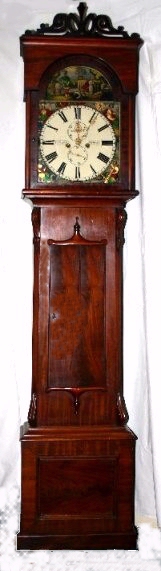
Care and Adjustment of Clocks
The main factors that affect the time keeping of clocks, are as follows: temperature, vibration and the clock being level. Clocks are also known to suffer from draughts, investigation by small children, animals (particularly cats), and vigorous dusting
If your clock is giving trouble, then please do check the following points before calling us out. If you prefer, we are happy to fix these minor problems for you, but please note that we have to cover the costs of offering this service. Therefore we provide this guide to help you to avoid incurring an unnecessary callout charge.
Position
Clock Beat
Time Keeping
Position
Long-case clocks were designed to stand on solid floors. Modern houses, with suspended floors and fitted carpets, do not
provide the stability the long case clock requires. If the carpet has a deep pile, then a solid wooden board should be
placed under the clock to stop the feet from compressing into the carpet.
It may be necessary to screw the case of the clock to the wall to provide the required rigidity.
Mantle Clocks should be placed on a solid level shelf or heavy piece of furniture (not over a source of heat)
Wall clocks should be hung from a secure fixing. If the wall is uneven, packing should be placed between the wall and the clock to increase rigidity.
Once the clock is level, the next point to check is that the clock is in 'beat'.
First listen to the beat of the clock (this is not the pitch of the tick but merely the regularity of it).
If the clock gives a regular: Tick......Tock......Tick......Tock......Tick......Tock...... then the clock is in beat. However, if the beat is as follows: Tick..Tock. .. .....Tick..Tock . ......Tick..Tock the clock is not in beat and the following procedure needs to be followed: ( please see below for exceptions to this rule. ) Raise one side of the clock at a time ( for wall clocks - move the bottom of the clock to first one side then the other). Note which side, when raised, brings the clock into beat. Bend the crutch of the pendulum carefully towards this side. Repeat as necessary. |
![]() |
A couple of exceptions are:
a) Round French movements, the final adjustment can be made by slightly rotating the movement in the case before re-tightening the fastening screws
b) Modern clocks, which have a clutch built into the top of the crutch and will allow adjustment to be made with slight pressure on the bottom of the crutch only.
c) Wall Clocks - The final adjustment can be made by moving the bottom of the clock very slightly to one side
If your clock constantly gains or loses over a period of time, then you need to adjust the length of your pendulum. The most common way to do this is by moving the regulating nut under the pendulum.
Raising the pendulum (turning the nut clockwise) will speed up the clock. To be used when the clock loses time. Remember Clockwise Cwuicker (Quicker!!)
Lowering the pendulum (turning the nut anticlockwise) will slow down the clock. To be used when the clock gains time.
Some French & American clocks have a small square shaft protruding through the clock face above the 12 o'clock position. This adjusts the pendulum, as described above, without you having to disturb the position of the clock. It is normally adjusted with a small key.
However, some spring driven clocks may gain or lose according to how much the spring is wound i.e. they may lose slightly as they near the time they require rewinding. This is because the power output from some springs is not constant.
Disclaimer
These notes are for your guidance. They are given in good faith but should not be considered to be a definite explanation of the subject. The author cannot accept any responsibility for any loss or damage occurring through any person following the advice given above either in adjusting their own or other persons' clocks.
You can download this handy guide as a PDF.
Requires Adobe Reader.